


The dogs of Spain who had places to be
There is something deeply satisfying about a dog who has worked out the important things in life. Not “sit”. Not “stay”. Not “heel”. The important things.
- Where the food is.
- Which humans can be trusted.
- Which door opens at lunchtime.
- When the bus arrives.
- And, ideally, which establishment serves sausages.
We recently came across the story of Ratty, the Jack Russell from Dunnington who apparently caught the bus into York (England) by himself, went to the pub, accepted sausages and water from the staff and then got a lift home from the barmaid at closing time. When his favourite pub changed hands and banned dogs, Ratty simply found another one. It sounds like the sort of story that gets embellished every time somebody posts it on Facebook. Except that Ratty really did exist.
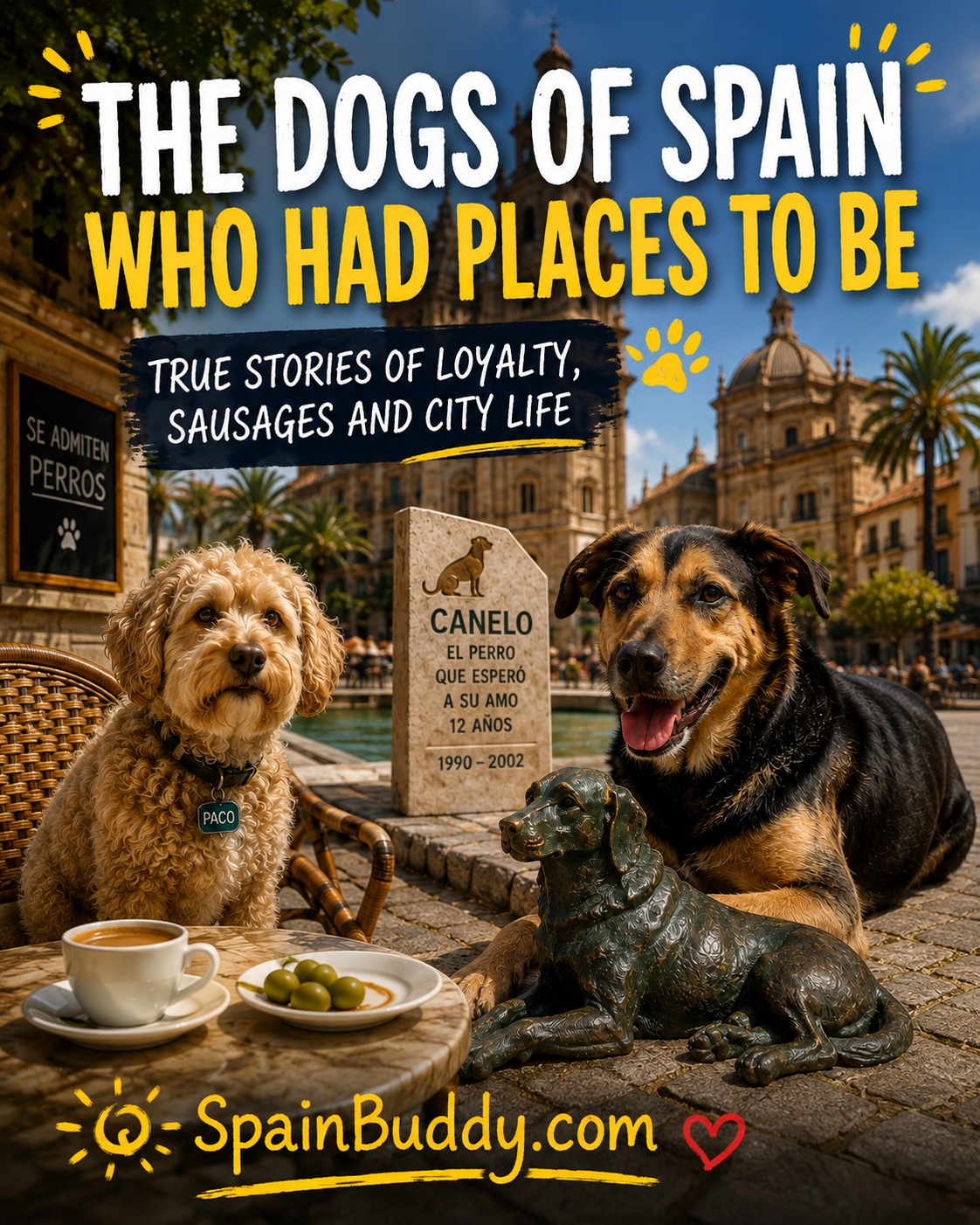
The dogs of Spain who had places to be
So we wondered: does Spain have dogs like this?
It turns out that Spain has several. Some are heart-breaking, some are hilarious, and at least one appears to have been considerably better connected than most humans. Here are just three of them.
Paco: Madrid’s original celebrity dog
Long before Instagram, TikTok or people filming their dogs eating watermelon, Madrid had an influencer. His name was Paco.
Paco was a stray dog who became extraordinarily famous in Madrid in the late 19th century. He had no owner, but that didn’t seem to bother him. Instead, he effectively adopted the city and allowed the city to adopt him.
Paco developed a particular liking for cafés and restaurants. He became a regular at the Café de Fornos, where writers, politicians and members of Madrid’s establishment gathered. The Marquis of Bogaraya took a liking to him and gave him the name Paco. Before long, the dog was a familiar presence among Madrid’s café society.
And Paco wasn’t merely tolerated. He was famous. He attended theatres, restaurants, cafés, the horse races and the bullring. Newspapers wrote about him. Songs and poems were produced in his honour. He became so well known that businesses reportedly sold products using his name. The press even followed his exploits in much the same way modern newspapers follow celebrities.
The bullring, unfortunately, was where Paco’s career came to an end. In June 1882, he jumped into the arena during a bullfight and began causing the sort of disruption that might reasonably be expected when a dog decides to participate in a sporting event. A bullfighter eventually stabbed him to get him out of the way. Paco died several days later, and the incident caused such outrage that there were apparently fears the bullfighter would be attacked by the crowd.
Paco was stuffed by a taxidermist and displayed in a Madrid tavern before eventually being buried in El Retiro. Madrid now has a bronze statue of him in Calle Huertas, installed in 2023.
So technically, Paco was Spain’s first dog influencer. He just didn’t have a ring light.
Rufo: the dog who belonged to an entire city
If Paco was Madrid’s dog, Rufo was Oviedo’s. Rufo appeared in Oviedo in the 1980s and became a permanent part of city life. He was a cross between a German Shepherd and a Mastiff and lived largely on the streets, but calling him a stray doesn’t really tell the whole story. He was, in effect, a communal dog.
People fed him. People looked after him. During cold weather he was allowed to sleep in warm building entrances. The city authorities took responsibility for his vaccinations, deworming and bathing. Rufo also had a remarkable talent for being wherever something was happening.
He turned up at football matches, official ceremonies, demonstrations and other public events. On one occasion, according to contemporary recollections, organisers of a demonstration apparently refused to start until Rufo had arrived. He eventually turned up about five minutes late. Quite right too.
He was a member of the community. When Rufo was taken to the municipal dog shelter on one occasion, Oviedo objected. His supporters organised a demonstration demanding that he be returned to the streets. He eventually died in 1997.
Nearly two decades later, Oviedo gave him a bronze statue, funded through a popular campaign. Thousands of people supported the project and around €6,000 was raised for the sculpture.
Today you can find Rufo sitting on Calle Doctor Casal, looking for all the world as though he’s waiting to see what the city is getting up to next. Asturias’ tourism website even includes him among the city’s must-see characters for people visiting Oviedo with their dogs. Frankly, that’s a better retirement package than some people get.
Canelo: the dog who waited
Then there’s Canelo in Cádiz. This is the one that makes you reach for the tissues. Canelo was a mixed-breed dog whose owner regularly went to Hospital Puerta del Mar for medical treatment. In 1990, the man went into the hospital and never came back out. He had died inside.
Canelo didn’t know that. He waited outside. And continued waiting. For 12 years.
Hospital staff, local residents and passers-by knew him and looked after him, giving him food, water and places to sleep. On more than one occasion he was taken to the municipal animal facility because he was considered a stray. People subsequently intervened to get him released, and he returned to the hospital. Canelo eventually died in 2002 after being hit by a vehicle near the hospital.
His story became part of Cádiz folklore, and in 2004 a street alongside the hospital was named after him. A plaque honours the dog who spent 12 years waiting for a man who was never coming back. Canelo’s story has subsequently been turned into an animated short film, meaning that, more than two decades after his death, he is still introducing people around the world to the rather extraordinary loyalty of one Cádiz dog.
There is one important caveat with Canelo’s story. Some of the more poetic details repeated online, including the exact words his owner supposedly said to him, have become part of the legend and cannot be independently verified. The basic story, however, is extensively documented.
Spain may have a thing about dogs having their own routines
There is an interesting common thread running through these stories. These aren’t dogs of Spain who were trained to perform extraordinary tricks. They’re dogs who appear to have developed their own understanding of the world around them.
- Paco worked out where the interesting people and free food were.
- Rufo worked out that an entire city was basically his extended family.
- Canelo worked out where his person had disappeared and simply refused to give up on him.
And that brings us back to Ratty. Spain may not have an exact equivalent of the Jack Russell who independently caught the No. 10 bus into York for a sausage and a pint-adjacent experience. But it does have something arguably just as impressive. It has dogs who became part of their cities. And perhaps that’s the particularly Spanish bit.
Paco wasn’t merely a stray wandering around Madrid. He became a fixture of café society. Rufo wasn’t merely a homeless dog in Oviedo. He became a citizen. Canelo wasn’t merely a dog sitting outside a hospital in Cádiz. He became everybody’s dog.
And, of course, Spain now has another reason for dogs to be making independent travel plans. Since July 2026, Renfe has allowed dogs weighing up to 40kg to travel alongside their owners on all of its commercial and public-service trains, with dedicated pet-friendly spaces. So perhaps we’re just waiting for the next Ratty. A Spanish dog who studies the timetable, boards the train, gets off at the right stop and heads directly for the nearest tapas bar. Given what we’ve learned about Paco, I wouldn’t put it past them. And if the bar doesn’t allow dogs? Well, clearly the dog will just find another bar – as long as it has sausages.

Elle, along with Alan, is the owner of Spain Buddy and the busy web design business – Spain Web Design by Gandy-Draper.
Born a “Norverner”, she then spent most of her life “Dann Saff” before moving to Spain in 2006. Elle’s loves are Alan, the internet, dogs, good food, and dry white wine – although not necessarily in that order.
Disclaimer
Some of the links on this website may contain an affiliate link. It costs you no more to use one of these links, but we may receive a small payment for you doing so.
As an Amazon Associate we earn from qualifying purchases. Amazon and the Amazon logo are trademarks of Amazon.com, Inc. or its affiliates.
Information correct at time of publication.


